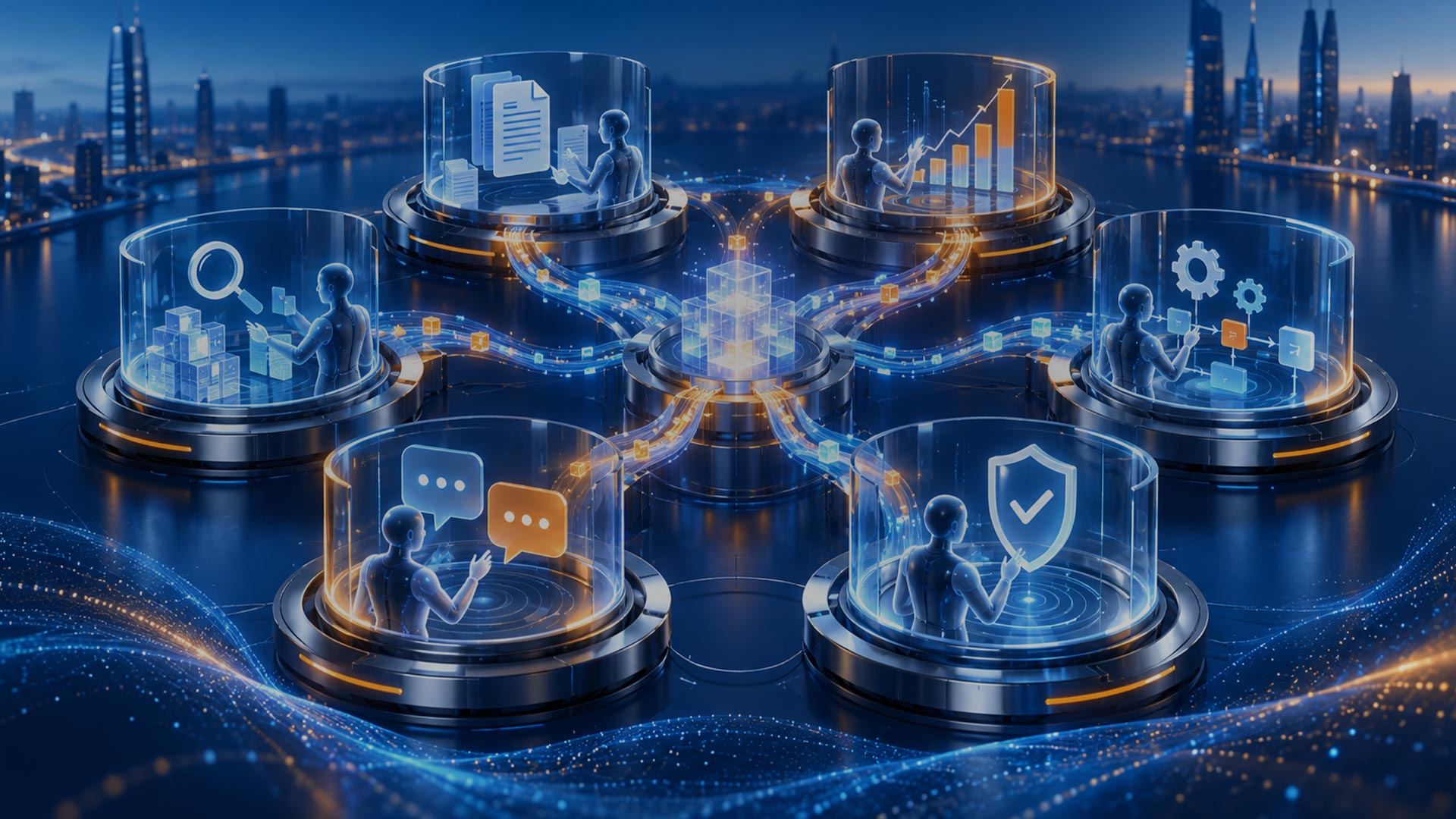
The era of the solo AI agent is over. The frontier has shifted to multi-agent ecosystems; networks where specialized agents coordinate autonomously to accomplish complex business objectives. Imagine one agent handling customer inquiries, another managing inventory, and a third monitoring supply chain disruptions. They don’t operate in silos, they share context, hand off work, and optimize around each other in real-time.
This shift is made possible by foundational frameworks like EIQ’s Agentic Mesh Architecture {aMa} and the emergence of agent-to-agent (A2A) protocol standards. Just as APIs enabled different software systems to communicate, A2A protocols allow agents, even from different vendors to coordinate without heavy custom integration. Major platforms are taking note: cloud marketplaces are beginning to vet agents for A2A compatibility, signaling that the infrastructure for true multi-agent coordination is ready for prime time.
From Task Optimization to Process Transformation - Why it matters
The leap from single to multi-agent is a fundamental architectural shift with profound business implications. A single agent can optimize a task, but a coordinated multi-agent system optimizes an entire business process.
Consider a classic enterprise workflow, a customer inquiry triggers an inventory check, which surfaces a supply chain constraint, which then initiates a procurement process and updates financial forecasts. In traditional automation, each step requires a human handoff or brittle integration code. With a system like our {aMa}, the entire chain executes autonomously. Its Marketplace dynamically forms the right team of agents, while its Trust and Safety System ensures all decisions align with overarching business priorities, transforming a fragmented procedure into a cohesive, intelligent operation.
A Financial Services Use Case
Early deployments are proving the measurable impact of this approach. One financial services client implemented a five-agent system on the EIQ platform for loan underwriting, incorporating specialized agents for document verification, credit scoring, compliance checking, risk assessment, and approval routing.
- Processing time dropped by 67%.
- Error rates decreased by 41%.
Critically, the system demonstrated continuous improvement through agent-to-agent feedback loops within the {aMa}, with each agent learning from the patterns identified by the others.
Industry analysis suggests the shift to multi-agent architectures is accelerating at a remarkable pace, fundamentally reshaping how enterprises operate.
Navigating the New Complexity: How {aMa} Provides the Answer
Multi-agent orchestration inevitably introduces new layers of complexity. This is precisely why the underlying architecture is not a commodity but is the strategic differentiator.
EIQ’s Agentic Mesh Architecture {aMa} was engineered specifically to solve the core challenges of this new paradigm:
Conflict Resolution
What happens when two agents optimize for different outcomes? {aMa}’s Trust and Safety System acts as a built-in governance layer, adjudicating competing recommendations based on configurable business rules and priorities.

State Management
How do agents share context without creating data chaos? {aMa} utilizes a persistent, centralized context layer and its MCP Registry to maintain real-time, consistent state across all agents, eliminating synchronization nightmares.

Observability
How do you debug a failure in a chain of autonomous decisions? {aMa} provides end-to-end traceability, offering a clear audit trail across the entire agent network. This turns the "black box" into a transparent system.

Conclusion
The enterprises winning with agentic AI are the ones who have mastered orchestration. A brilliantly coordinated network of specialized agents will consistently outperform a collection of isolated geniuses.
This is where our fundamental differentiation materializes in production.
The EIQ’s Agentic Mesh Architecture {aMa} is an orchestration layer; the essential governance framework for mission-critical agent networks. It ensures that the immense potential of multi-agent systems is realized with the reliability, control, and visibility that enterprise-scale business requires.